

Are you tired of your suppliers treating you like just another purchase order, with delayed shipments and inconsistent quality during peak seasons? In the glass industry, a transactional relationship is a vulnerability. The real competitive advantage belongs to those who can turn their manufacturers into strategic partners 1{#ref-1}, unlocking innovation, priority service, and better terms.
To upgrade your relationship with a glass factory, you must move beyond price haggling. Negotiate better payment terms by building a history of reliable payments. Secure priority production through transparent forecasting and off-peak ordering. Propose joint product development by aligning your R&D goals with the factory’s capabilities. Ultimately, transparent communication about long-term objectives is the key to building mutual trust and leverage.
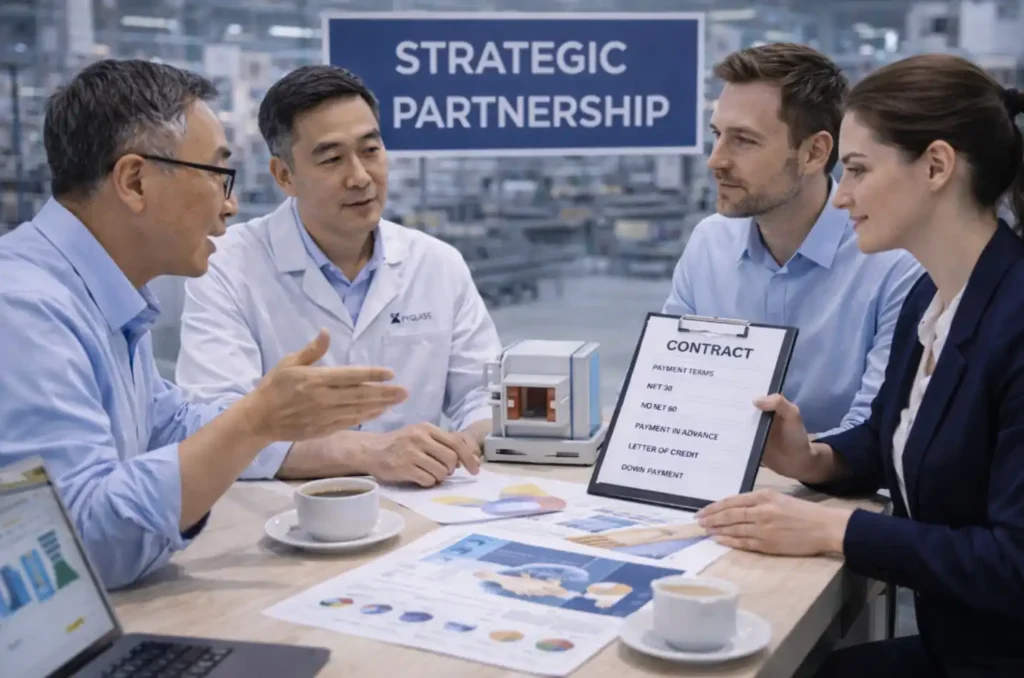
At our 200,000㎡ manufacturing base in Zibo, we work with hundreds of global brands. The ones who get the best service, the newest technologies, and the most favorable terms aren’t always the biggest; they are the ones who treat us as a strategic extension of their own business. Here is a guide from the factory floor on how to build that kind of relationship.
How can I negotiate better payment terms after my first few orders?
New buyers often start with strict terms like “100% T/T before shipment.” This ties up your cash flow and limits your growth. Moving to more flexible terms like “30% deposit, 70% against Bill of Lading copy” or even credit terms requires building a track record of financial reliability.
Negotiate better payment terms by first establishing a flawless payment history on your initial orders. Once trust is established, propose a gradual transition: start by reducing the deposit percentage, then move to payment upon shipment documentation, and eventually request credit insurance (like Sinosure in China) to back deferred payment terms of 30-60 days.

The Trust Ladder: A Step-by-Step Approach
In our finance department, we have a “risk profile” for every customer. A new client like Jacky starts as high-risk. The only way to lower that risk is through consistent performance.
- Orders 1-3: Pay on time, every time. Do not ask for extensions. This is your “credit building” phase.
- Order 4: Request a small change. For example, if you were paying 50% deposit, ask to lower it to 30%. Frame it as a way to free up capital for marketing, which will lead to more orders.
- Order 6+: Introduce the idea of payment against shipping documents (OA/DP). This shifts the risk slightly but is standard for established relationships.
Utilizing Credit Insurance Tools
For Chinese manufacturers, the Sinosure 2{#ref-2} (China Export & Credit Insurance Corporation) is a game-changer. If your company has good credit standing in your home country (e.g., Canada), we can apply for a Sinosure credit line on your behalf. If approved, Sinosure insures the payment, which allows us to offer you terms like Net 60 days 3{#ref-3} with minimal risk to ourselves. Proposing this shows you understand international trade finance and are looking for a professional, long-term solution.
What can I do to get priority production during the busy season?
In the months leading up to Christmas or Chinese New Year, our furnaces are running 24/7, and capacity is fully booked. This is when “transactional” clients get their orders delayed, while “strategic” partners get their orders pushed to the front of the line.
Get priority production by providing rolling 12-month forecasts that allow the factory to plan capacity in advance. Practice “production level-loading” by placing orders during off-peak months (typically March-June) to build inventory. In return, the factory is more likely to prioritize your urgent orders during the busy Q3-Q4 season.

The Power of Forecasting
A purchase order (PO) is a demand; a forecast is a plan. When you send us a PO out of the blue in September, we have to scramble to fit it in. But if you provide rolling 12-month forecasts 4{#ref-4} that you update quarterly, we can reserve production slots for you months in advance. We can also order raw materials (like high-quality borosilicate sand 5{#ref-5}) and packaging ahead of time, avoiding last-minute shortages.
“Level-Loading”: Helping Us Help You
Glass furnaces must run continuously; shutting them down is incredibly expensive. Our biggest challenge is filling production capacity during the “slack season” after the Chinese New Year. A strategic partner will practice production level-loading 6{#ref-6} by placing orders during these quiet months to build up their inventory. This helps us keep our machines running efficiently. In gratitude, when the peak season hits, the clients who supported us in the off-season get first priority.
Production Capacity Planning Table
| Aktion | Transactional Buyer Behavior | Strategic Partner Behavior | Factory Response |
|---|---|---|---|
| Forecasting | Sends POs sporadically | Provides 12-month rolling forecast | Reserves capacity and materials in advance |
| Ordering Time | Places orders only during peak season | Places “level-loading” orders in off-peak | Prioritizes orders during busy periods |
| Kommunikation | Only contacts finance/sales | Regular syncs with production managers | Proactively identifies and solves bottlenecks |
How do I propose a joint product development plan with my manufacturer?
Many buyers treat factories as “print shops”—they send a drawing and expect a product. But your manufacturer is a treasure trove of engineering knowledge. Unlocking this expertise through joint development can lead to better products and lower costs.
Propose a joint product development plan by framing it as a mutual opportunity for growth and innovation. Start with a “Value Engineering” workshop to optimize existing designs for manufacturing efficiency. Then, propose a co-investment model for new custom molds or specialized equipment, formalizing a long-term asset-sharing agreement that benefits both parties.

The “Value Engineering” Workshop
Before you ask for something new, improve what you already have. Propose a meeting with our engineering team to review your current best-sellers. Use the principles of Value Engineering 7{#ref-7} to ask: “How can we reduce the breakage rate of this item? Is there a way to redesign the lid to make it cheaper to produce?” Our engineers might suggest a slight change in the glass wall thickness or a different mold release angle that improves yields.
The ultimate sign of a strategic partnership is shared financial risk. If you have a unique product idea that requires specialized equipment, such as an electrostatic sprayer 8{#ref-8}, propose splitting the investment. For example, you pay 50% of the mold cost, and we pay 50%. This can be formalized through an asset-sharing agreement 9{#ref-9} that ensures you get exclusivity on that design for a certain period. This “golden handcuff” ties our success to yours.
Why is transparent communication key to building long-term leverage with factories?
In a transactional relationship, information is hoarded like a weapon. In a strategic partnership, information is shared like fuel. Transparency about your business goals, challenges, and even your mistakes is what builds the trust necessary for long-term leverage.
Transparent communication builds leverage by fostering mutual trust and aligning long-term business objectives. Sharing your growth forecasts, marketing plans, and even customer complaints allows the factory to understand your needs deeply and proactively offer solutions. This openness transforms the relationship from adversarial to collaborative, where the factory becomes personally invested in your success.
Don’t just tell us what you need; tell us warum you need it. If you need a price reduction, explain that it’s because a major retailer is demanding it for a nationwide promotion. When we understand the context, we are more likely to work with you to find a solution—perhaps through a temporary discount or a re-engineered product—rather than just saying “no.”
The Importance of Multi-Level Communication
A common mistake is limiting communication to just the buyer and the salesperson. A strategic partnership involves multi-level connections. Sharing business objectives 10{#ref-10} across all departments ensures that everyone is moving in the same direction. Your quality manager should talk directly to our QC supervisor. Your supply chain lead should have a direct line to our production planner. This network of relationships ensures that small problems are solved quickly at the operational level.
Schlussfolgerung
Upgrading from a “one-off deal” to a strategic partner is a deliberate process of building trust, sharing risk, and aligning goals. By negotiating smarter payment terms based on performance, securing priority through forecasting and level-loading, engaging in joint product development, and practicing radical transparency, you can transform your glass factory into your most valuable competitive advantage. At PYGLASS, we are ready to be that partner for brands that are serious about long-term growth.
Fußnoten
1. Professional insights into the power of strategic partnerships for long-term business growth. ↩︎
2. Official portal of China Export & Credit Insurance Corporation for international trade protection. ↩︎
3. Understanding Net 60 payment terms and their impact on corporate cash flow. ↩︎
4. Guide to implementing rolling forecasts to improve supply chain planning and accuracy. ↩︎
5. Information on the specific silica sand purity required for manufacturing industrial borosilicate glass. ↩︎
6. Explanation of Heijunka (level-loading) techniques to optimize factory production and stability. ↩︎
7. Understanding Value Engineering to improve product function while reducing manufacturing costs. ↩︎
8. Technical overview of electrostatic spraying technology for precision glass finishing. ↩︎
9. Legal definition and best practices for asset-sharing agreements between business partners. ↩︎
10. Strategic importance of aligning organizational goals with vendor and partner operations. ↩︎
 DE
DE  EN
EN  ES
ES  PT
PT  FR
FR  CS
CS  RU
RU  ES_AR
ES_AR  AR
AR  JA
JA