

In the global glassware trade, a single batch of non-compliant products can lead to a total customs seizure or a massive retail recall. For purchasing managers, certifications are not just pieces of paper; they are the legal and safety shield for your entire supply chain. Choosing a partner with the wrong credentials—or none at all—is a risk that can sink your brand’s reputation in weeks.
When selecting a glassware manufacturer, the “Big Three” certifications are ISO 9001 for quality management, FDA (US) or LFGB (EU) for food safety, and BSCI for ethical labor audits. Food-grade glassware must specifically pass lead and cadmium leaching tests to meet FDA and California Proposition 65 requirements. At PYGLASS, we maintain a 200,000㎡ manufacturing base that has passed rigorous audits by Walmart and Costco, ensuring every piece of borosilicate glass complies with international DGCCRF and LFGB standards. Verification is key: always cross-reference certificate numbers on official databases like the IAF CertSearch or the amfori BSCI platform.

Navigating the world of international standards can feel like a maze, especially with the 2026 updates to sustainability and digital traceability. As a manufacturer, we see many buyers focus only on the price per unit, forgetting that a $0.10 saving can result in a $100,000 fine if the glass contains trace amounts of heavy metals 1{#ref-1}. To protect your investment, you need to know which certifications are mandatory for your specific market and how to spot a fake certificate before you sign a contract.
Do I need FDA or LFGB certification for importing glassware to my market?
Our export team deals with this question daily because the answer changes depending on where your warehouse is located. In our factory, we produce to both standards simultaneously to ensure that our global partners can shift inventory between North America and Europe without legal friction.
FDA compliance is the mandatory baseline for the United States, focusing heavily on lead and cadmium extraction limits. For the European market, LFGB (Lebensmittel- und Futtermittelgesetzbuch) is the “Gold Standard,” and it is significantly more stringent than the FDA, requiring more rigorous testing for sensory perception (smell and taste transfer). If you are importing to Germany or France, LFGB is non-negotiable; if you are in the US, while FDA is the law, having LFGB certification actually gives you a competitive edge as it signals superior product purity and safety.

FDA vs. LFGB: The Technical Gap
In my 15 years in the industry, I’ve noticed that many buyers assume FDA and LFGB are interchangeable. They aren’t. Our lab engineers have found that while the FDA focuses on “total immersion” tests for heavy metals, the German LFGB standards require testing for a broader range of chemicals and even monitor how the glass affects the “organoleptic” properties of food—essentially, whether the container changes the taste or smell of what’s inside.
High-borosilicate glass is naturally superior here because it is non-porous. However, the silicone seals and plastic lids of your food containers must also pass these tests. When we source materials for our meal prep sets, we ensure the silicone is platinum-cured 2{#ref-2} to meet LFGB standards, which far exceed the basic FDA requirements for plasticizers and BPA.
Global Market Compliance Comparison
To help you decide which standard to prioritize, we’ve mapped out the key requirements by region.
| Région | Primary Standard | Key Focus Areas | Risk Level if Missing |
|---|---|---|---|
| ÉTATS-UNIS | FDA / Prop 65 | Lead & Cadmium leaching, chemical labeling. | High (Customs seizure) |
| European Union | LFGB / EU 1935/2004 | Sensory transfer, chemical migration, BPA. | Very High (market ban) 3{#ref-3} |
| France | DGCCRF | Specific glass composition limits. | High (Regional fines) |
| Mondial | ISO 22000 4{#ref-4} | Food safety management systems. | Medium (B2B trust) |
The California Proposition 65 Factor
If you are selling in California, “FDA approved” is not enough. You must also comply with Prop 65, which requires clear warnings if the product contains any of over 900 chemicals known to cause cancer or reproductive harm. Our production lines use only lead-free glazes and pure borosilicate formulations to ensure your products can skip the “warning label” and go straight to the premium shelves.
How do I verify if a factory’s ISO 9001 certificate is authentic?
We have seen many “trading companies” use Photoshop to create fake ISO 9001 certificates. At our facility, we encourage our visitors to scan our QR codes and check our registration directly on the official IAF database because transparency is the foundation of a real manufacturing partnership.
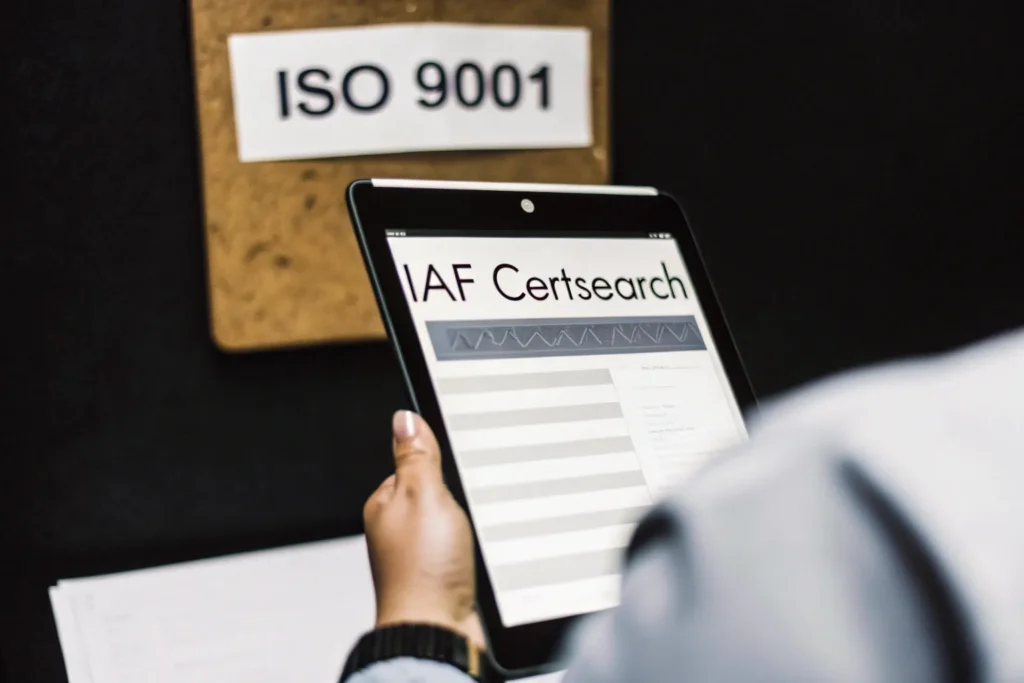
To verify an ISO 9001 certificate, you must first check the “Accreditation Body” (like UKAS or ANAB) and then enter the certificate number into the IAF CertSearch website. A legitimate certificate will list the factory’s full legal name and the specific “Scope of Certification”—for example, “Manufacturing and Sales of Borosilicate Glassware.” If the certificate only lists “Sales” or is registered to a small office address instead of a manufacturing base, you are likely dealing with a middleman, not a factory.
The Three-Step Verification Process
Our quality control team suggests a “trust but verify” approach. Don’t just look at the PDF they send you. Follow these three steps to ensure you are working with a manufacturer that actually follows quality management systems:
- Cross-Check the Address: Does the address on the ISO certificate match the factory address on the business license? If the ISO is for a headquarters in Shanghai but the factory is in Shandong, you need to verify if the factory site itself is covered.
- Verify the Expiry Date: ISO certificates must be renewed through annual surveillance audits. Check the “valid until” date. If it’s expired, the factory’s quality system is no longer being monitored.
- Check the Scope: This is where many get caught. A factory might have an ISO for “Packaging” but claim it covers “Glass Melting.” Make sure the scope specifically includes the manufacturing process of the products you are buying.
Why ISO 9001 Matters for Lead Times
ISO 9001 isn’t just about quality; it’s about process. Our factory uses the ISO framework to manage everything from raw material intake to final palletizing.
| ISO Element | Benefit to You | Impact on Your Order |
|---|---|---|
| Process Control | Fewer production errors. | Reduces the risk of late-stage defects. |
| Document Control | Accurate specification tracking. | Ensures your custom logo is exactly right. |
| Corrective Action | Systematic problem solving. | Prevents the same mistake from happening twice. |
| Audit Trails | Full traceability. | Crucial if a quality issue is found post-shipment. |
Red Flags to Watch For
If a supplier refuses to provide the original PDF of the certificate or if the stamp of the auditing body looks blurry or altered, walk away. In 2026, with digital certificates being the norm, there is no excuse for “losing” or “misplacing” official documentation. A professional manufacturer like PYGLASS will have these ready in your IAF CertSearch 5{#ref-5} client portal.
Why is BSCI audit compliance crucial for my retail supply chain?
If you are selling to major retailers like Walmart, Costco, or Target, a quality product isn’t enough; you must also prove the product was made ethically. We maintain our BSCI (Business Social Compliance Initiative) status not just as a “badge,” but as a commitment to the safety and health of our workers.
BSCI audit compliance is crucial because it provides a standardized, third-party verification of a factory’s labor practices, ensuring no forced labor, no child labor, and fair compensation. For a retail purchasing manager, a “Grade A” or “Grade B” BSCI report is often a mandatory prerequisite for onboarding a new supplier. Without it, you face massive reputational risks and potential boycotts if a “social audit” reveals poor working conditions in your supply chain.

The amfori BSCI Framework
In our 200,000㎡ manufacturing base, we adhere to the amfori BSCI Code of Conduct. This involves regular, often unannounced, audits that look at everything from fire safety to the transparency of our payroll. For a buyer, the most important part of the BSCI report is the Corrective Action Plan 6{#ref-6} (CAP). If a factory has a “C” rating, it’s not necessarily a deal-breaker, but you must check their CAP to see if they are actively fixing the issues.
Protecting Your Brand Reputation
We have seen brands destroyed overnight because of a single photo of a dangerous workshop. By choosing a BSCI-compliant partner, you are buying “Reputation Insurance.” The audit covers:
- occupational health & safety 7{#ref-7}: Essential in high-heat glass melting environments.
- No Bonded Labor: Ensures all workers are there of their own free will.
- Environmental Protection: While primarily social, BSCI also looks at waste management and chemical handling.
ESG and the 2026 Supply Chain
The trend for 2026 is moving toward “ESG” (Environmental, Social, and Governance) scores. Retailers are now looking beyond the product to the factory’s carbon footprint 8{#ref-8} and energy efficiency.
| Certification / Audit | Domaine d'intervention | 2026 Trend |
|---|---|---|
| BSCI / Sedex | Labor & Ethics | Mandatory for Tier-1 retailers. |
| ISO 14001 | Environmental Management | Growing demand for “Green Packaging.” |
| ISO 50001 | Efficacité énergétique | Vital for reducing carbon tax impact. |
| Cradle to Cradle | Circular Economy | High-end brands seeking 100% recyclability. |
Our mission at PYGLASS—Safer, Healthier, Greener—is built on these standards. We don’t just melt glass; we manage a social and environmental ecosystem that our partners can be proud to associate with.
What specific safety standards must my glassware meet for the US and EU markets?
Safety in glassware is about more than just “not breaking.” It’s about how the glass behaves under stress. At our engineering center, we subject our products to tests that go far beyond what a normal kitchen would ever require.
For the US market, your glassware should meet ASTM (American Society for Testing and Materials) standards, specifically ASTM C148 for annealing quality and ASTM C149 for thermal shock resistance. For the EU market, the CE Mark is often required for certain types of glass products, alongside the 1935/2004/EC regulation for food contact. Meeting these standards ensures that a glass container won’t explode when moved from a freezer to a preheated oven—a critical safety feature for borosilicate products.

Thermal Shock: The Real Test of Quality
Our engineers have found that “Soda-Lime” glass (standard cheap glass) often fails thermal shock tests above a 50°C temperature difference. In contrast, our high-borosilicate glassware is tested to withstand a 120°C to 150°C résistance aux chocs thermiques 9{#ref-9}. This means you can take it from the fridge and put it straight into a microwave or oven without it shattering.
When you are importing, ask for the “Thermal Shock Test Report.” If the manufacturer cannot provide one, they are likely selling low-quality glass that poses a serious injury risk to your customers. In the US, a single “exploding glass” lawsuit can cost more than your entire year’s inventory.
Annealing and Stress Relief
Annealing is the process of slowly cooling glass to relieve internal stress. If glass is cooled too quickly, it becomes “stressed” and can shatter spontaneously weeks later. We use ASTM C148 methods (Polariscope testing) 10{#ref-10} to ensure every batch is stress-free.
- ASTM C148: Measures the “Retardation” of light through the glass to detect internal stress.
- ASTM C149: Submerges hot glass into cold water to test for thermal fracture.
- ASTM C147: Tests the internal pressure strength, vital for glass bottles and jars.
Safety Standard Checklist for Buyers
Before you approve a production run, ensure your “Spec Sheet” includes these requirements.
| Test Parameter | US Standard | EU Standard | PYGLASS Capability |
|---|---|---|---|
| Choc thermique | ASTM C149 | EN 1183 | Up to 180°C ΔT |
| Heavy Metals | FDA / Prop 65 | LFGB / REACH | 0% Lead & Cadmium |
| Annealing Quality | ASTM C148 | ISO 7459 | Grade A (Stress-free) |
| Impact Strength | ASTM C1601 | EN 12600 | High-Impact Resistance |
By insisting on these specific technical standards, you filter out the “workshop” factories and ensure your brand is associated with safety and durability.
Conclusion
Choosing the right glassware manufacturer is a balance of quality management (ISO 9001), food safety (FDA/LFGB), and ethical responsibility (BSCI). In 2026, verification is your best defense against supply chain disruptions and legal risks. Always verify certificates through official channels, understand the technical differences between regional standards, and never compromise on safety testing like thermal shock resistance. At PYGLASS, we believe that transparency is the most important product we offer. Our 200,000㎡ facility is open for your audit, and our certifications are always ready for your verification.
Notes de bas de page
1. Overview of regulations regarding heavy metals and their impact on consumer product safety. ↩︎
2. Technical advantages of using platinum-cured silicone in high-purity food-grade components. ↩︎
3. Regulatory framework for preventing non-compliant food contact materials from entering the EU market. ↩︎
4. International standard for food safety management systems across the global supply chain. ↩︎
5. The global database for verifying the validity of accredited management system certifications. ↩︎
6. Understanding how Corrective Action Plans help resolve non-compliance issues in manufacturing. ↩︎
7. Global standards for maintaining a safe and healthy workplace in industrial environments. ↩︎
8. Methods for measuring and reducing the environmental impact of manufacturing operations. ↩︎
9. Scientific principles behind how materials survive rapid temperature changes without fracturing. ↩︎
10. Standard methodology for examining the quality of glass annealing through polarized light. ↩︎
 FR
FR  EN
EN  ES
ES  PT
PT  CS
CS  RU
RU  DE
DE  ES_AR
ES_AR  AR
AR  JA
JA