
Consumer demand for “plastic-free” living is skyrocketing, but as a purchasing manager, you face a brutal reality: eco-friendly products are often expensive and hard to scale. If your supply chain isn’t optimized for sustainability, you risk losing eco-conscious customers to competitors who offer greener solutions at better prices.
Balancing sustainability with high-volume production requires partnering with glassware manufacturers who utilize electric-hybrid furnaces, recycled cullet systems, and GRS-certified supply chains. By sourcing glass food storage containers wholesale made from high-borosilicate glass, brands can offer durable, infinitely recyclable products that reduce plastic waste. Choosing glass containers wholesale with eco-friendly lids like bamboo or stainless steel further ensures a plastic-free product line that meets global ESG standards.

Navigating the transition to a sustainable inventory model can feel like an uphill battle. At our 200,000㎡ manufacturing base in Zibo, we have spent years re-engineering our production lines to prove that “green” and “mass-market” are not mutually exclusive. This guide explores how to build a resilient, eco-certified supply chain that protects both the planet and your profit margins.
Why is high-borosilicate glass considered the most sustainable option for food storage?
Many buyers settle for cheaper soda-lime glass, but they ignore the environmental cost of frequent replacements. Low-quality glass breaks easily, leading to a “disposable” cycle that contradicts the very essence of sustainability.
High-borosilicate glass is the most sustainable option because its superior thermal shock resistance ensures extreme durability, lasting decades longer than standard glass. It is 100% recyclable, BPA-free, and chemical-resistant, making it a safer, long-term alternative to single-use plastics and lower-grade glassware that frequently ends up in landfills due to breakage.
The Longevity of Borosilicate 3.3
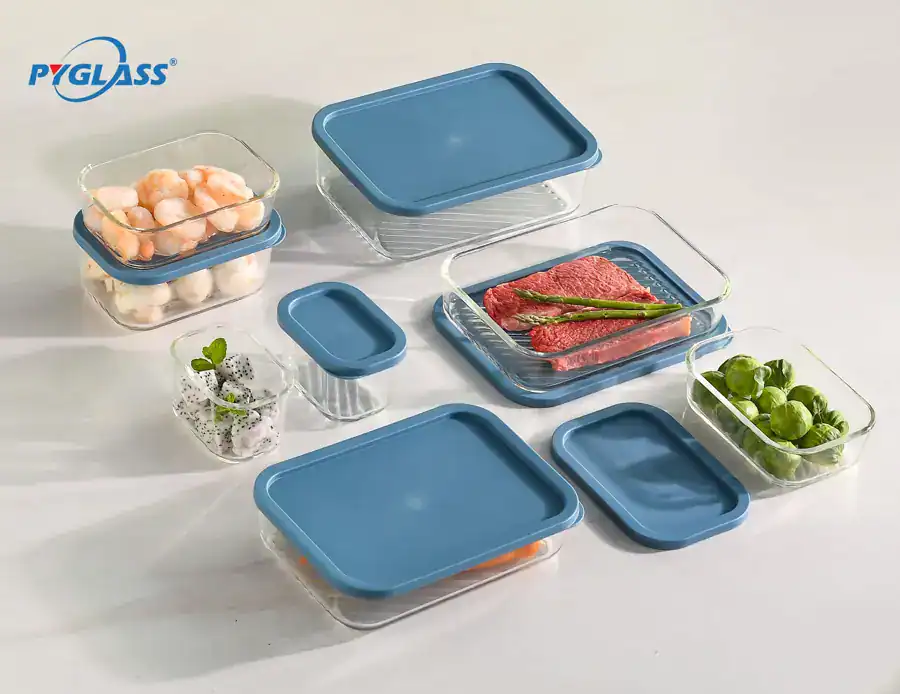
In our 15 years as glassware manufacturers, we have observed that the true measure of sustainability is a product’s lifespan. Our high-borosilicate 3.3 glass is engineered with a low coefficient of thermal expansion 1{#ref-1}. This means it can go from a -20°C freezer to a 400°C oven without cracking. For a consumer, this single container replaces the need for separate plastic storage bags, cheap plastic tubs, and aluminum foil. By reducing the number of products a household needs to buy, we significantly lower the total carbon footprint of their kitchen.
Furthermore, borosilicate glass is non-porous. Unlike plastic, it doesn’t absorb odors or leach chemicals like BPA and Phthalates 2{#ref-2} into food over time. When we produce these containers at our Zibo base, we ensure that the raw materials are high-purity silica sand 3{#ref-3} and boron trioxide, which are abundant natural resources. This chemical stability means the glass remains clear and safe for 20+ years, whereas plastic containers degrade and become hazardous within two.
Material Sustainability Comparison
| Feature | High-Borosilicate Glass | Soda-Lime Glass | Food-Grade Plastic |
|---|---|---|---|
| Recyclability | 100% (Infinite) | 100% (Infinite) | Limited (Down-cycling) |
| Durability | Extremely High | Moderate | Low (Scratches/Stains) |
| Thermal Resistance | Up to 120°C $\Delta T$ | Up to 40°C $\Delta T$ | Low (Melts in heat) |
| Chemical Leaching | Zero | Zero | High (BPA/Phthalates) |
| Lifespan | 10-20+ Years | 2-5 Years | 6-12 Months |
Circular Economy and Recycled Cullet
We are actively integrating the Circular Economy 4{#ref-4} model into our factory. This involves using “cullet”—recycled glass fragments—in our melting process. Using cullet reduces the melting temperature required in our kilns, which saves significant amounts of energy and lowers CO2 emissions. For every 10% of cullet we add to our batch, we reduce energy consumption by approximately 3%.
When you source glass food storage containers wholesale from a facility that prioritizes cullet usage, you are supporting a closed-loop system. We collect our own production scrap and re-melt it, ensuring that zero glass waste ever leaves our 200,000㎡ manufacturing base. This commitment to resource efficiency is a core part of our mission to be “Safer, Healthier, and Greener.”
How do glassware manufacturers China manage energy-intensive production while reducing carbon footprints?
The glass industry is traditionally energy-heavy, but 2026 has brought a new era of “Clean Melting.” As buyers look toward glassware manufacturers China for high-volume orders, the pressure to prove “Green Energy” usage is higher than ever.
Leading glassware manufacturers China are reducing their carbon footprints by switching from coal-fired to electric-hybrid furnaces and oxygen-fuel combustion technology. These advanced kilns reduce NOx emissions by 80% and CO2 by 20%. Many factories, including our Zibo base, are also installing massive solar arrays on warehouse rooftops to offset electricity consumption during the finishing and packing stages.
The Shift to Electric-Hybrid Melting
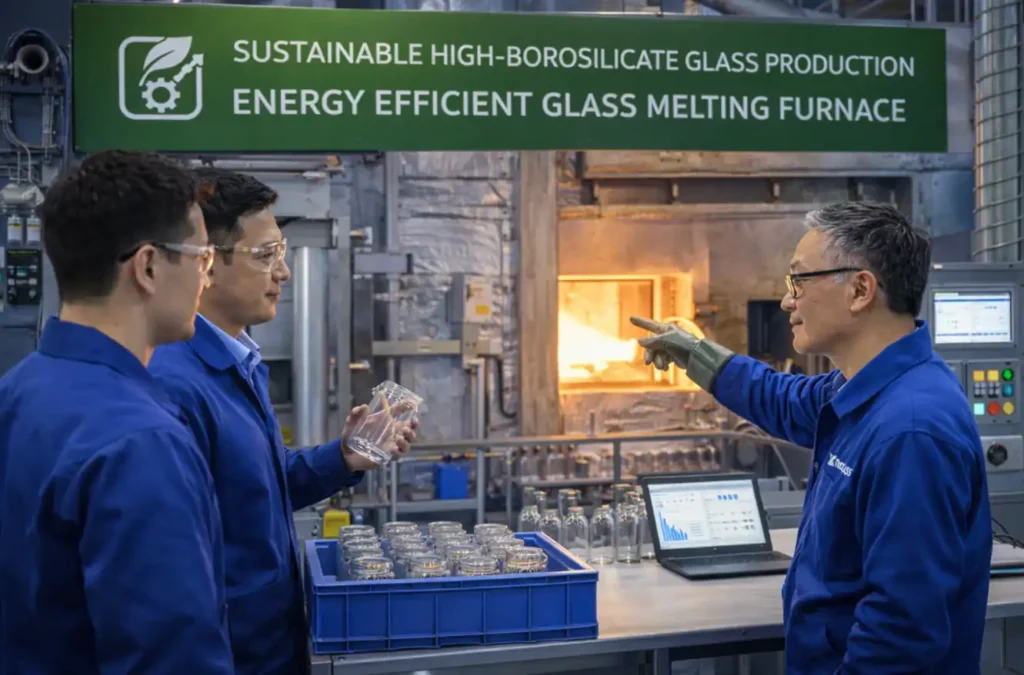
In our facility, the heart of our sustainability effort is the electric-hybrid furnace. Traditionally, glass furnaces burned heavy oil or natural gas 24/7. Today, our most advanced lines use “Electric Boosting,” where electrodes pass a current directly through the molten glass. This technology allows glassware manufacturers China to maintain the extreme 1,500°C temperatures required for borosilicate while drastically cutting direct fossil fuel combustion.
We have also implemented heat exchangers 5{#ref-5} within our waste heat recovery systems. The exhaust gases from our kilns are no longer just released into the atmosphere. Instead, we channel them through these systems to generate steam, which we use to pre-heat our raw materials or even provide heating for our worker dormitories. This “cascading” use of energy ensures that almost nothing is wasted.
Energy Innovation and Emission Reduction
| Technology | Environmental Impact | Benefit to the Buyer |
|---|---|---|
| Electric-Hybrid Kilns | 20% lower CO2 emissions | Stable pricing (less gas price volatility) |
| Oxy-Fuel Combustion | 80% reduction in Nitrogen Oxides 6{#ref-6} | Compliance with EU/US green regulations |
| Waste Heat Recovery | Increases energy efficiency by 15% | Lower overall manufacturing overheads |
| Solar PV Integration | Offsets peak-hour power usage | Enhanced “Green” brand storytelling |
| Automated Batching | Reduces raw material dust/waste | Consistent material quality and clarity |
Digital Monitoring and ESG Reporting
As professional glassware manufacturers, we understand that transparency is the new currency. In 2026, we utilize Internet of Things 7{#ref-7} sensors across our production floor to track the “Carbon Intensity” of every batch we produce. We can provide our global partners with detailed ESG (Environmental, Social, and Governance) reports that break down the kilowatt-hours used per kilogram of glass.
Can I source glass food storage containers wholesale that are truly plastic-free?
The biggest challenge in the “plastic-free” movement is the lid. While the glass is green, many glass food storage containers wholesale come with plastic lids and silicone gaskets that can eventually shed microplastics.
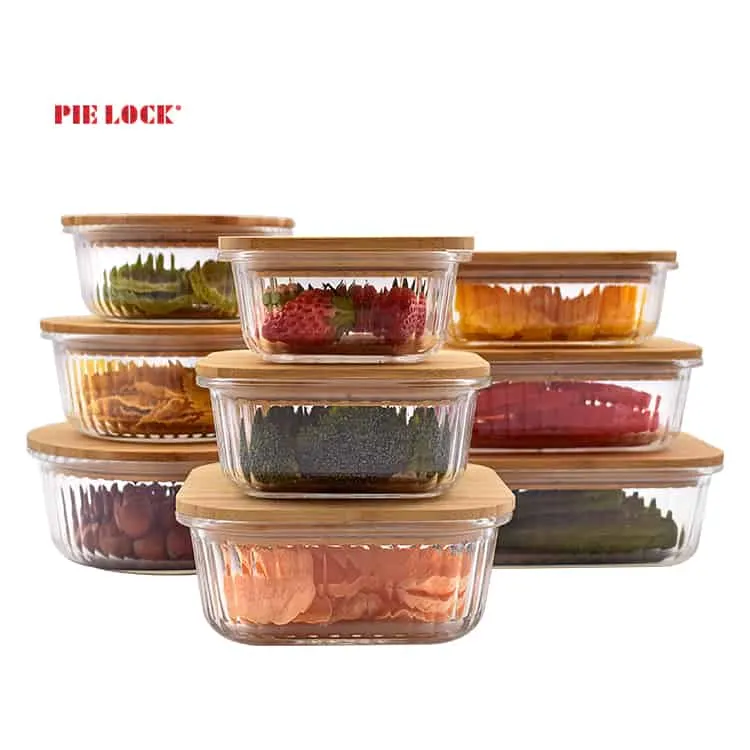
Yes, you can source truly plastic-free glass food storage containers wholesale by opting for lids made from FSC-certified bamboo, sustainable acacia wood, or food-grade 304 stainless steel. These materials, combined with high-purity silicone gaskets—which are derived from silica and are more eco-friendly than petroleum-based plastics—create a 100% plastic-free storage solution that appeals to the premium eco-conscious market.
Plastic-Free Component Options
| Lid Material | Sustainability Source | Best Use Case | Eco-Certification |
|---|---|---|---|
| Sustainable Bamboo | Fast-growing, carbon-sequestering | Dry storage / Countertop display | FSC (Forest Stewardship Council) |
| 304 Stainless Steel | Highly durable, 100% recyclable | Meal prep / Freezer-to-Oven | LFGB / FDA Food Grade |
| acacia wood 8{#ref-8} | Natural, biodegradable, durable | Premium gift sets / Serving | Sustainable Plantation Sourced |
| Cork Inserts | Renewable bark (non-harming) | Bottles / Spice jars | 100% Biodegradable |
| Platinum Silicone | Silica-based (non-petroleum) | Airtight gaskets / Suction seals | REACH / DGCCRF Compliant |
The Role of GRS and FSC Certifications
We don’t just take “eco-friendly” on faith; we verify it. For all our wooden and bamboo components, we maintain Forest Stewardship Council 9{#ref-9} chain-of-custody certificates. This ensures that the wood used in your containers doesn’t contribute to deforestation. For our silicone and recycled glass components, we are increasingly moving toward GRS (Global Recycled Standard) certification to provide full traceability from the waste stream to the finished product.
What are the long-term ROI benefits of choosing eco-certified glass containers wholesale?
Many purchasing managers are hesitant to pay the 10-15% premium for eco-certified glass containers wholesale. They worry that the upfront cost will hurt their immediate margins, but they ignore the “Hidden ROI” of sustainability.
The long-term ROI of choosing eco-certified glass containers wholesale includes significantly lower return rates due to superior durability, increased brand loyalty from the growing ‘LOHAS’ (Lifestyle of Health and Sustainability) demographic, and future-proofing against tightening environmental regulations. High-quality borosilicate glass protects your profit margins by reducing the cost of breakage in the supply chain and allowing for a higher retail price point.
Future-Proofing for 2026 and Beyond
The regulatory environment is changing fast. In 2026, governments across North America and Europe are introducing Extended Producer Responsibility 10{#ref-10} (EPR) laws. These laws make the brand responsible for the end-of-life cost of their products. By switching to glass containers wholesale now, you are exempting your brand from these upcoming taxes.
Conclusion
Sustainability is no longer a luxury; it is a fundamental requirement for market competitiveness in 2026. By understanding the superior durability of high-borosilicate glass and the energy innovations of leading glassware manufacturers China, you can build a brand that resonates with modern consumers. At PYGLASS, our 200,000㎡ facility is dedicated to helping you achieve this balance.
Footnotes
1. Technical definition of how glass reacts to temperature changes through expansion measurement. ↩︎
2. CDC factsheet on chemicals used in plastics and their potential impact on health. ↩︎
3. Explaining the natural properties and common uses of high-purity industrial silica sand. ↩︎
4. Framework for reducing waste through the reuse and recycling of finite resources. ↩︎
5. How heat exchangers transfer thermal energy to improve industrial energy efficiency. ↩︎
6. EPA guide on nitrogen oxide pollution and its effects on air quality and health. ↩︎
7. Overview of IoT technology and its application in smart manufacturing and data tracking. ↩︎
8. Characteristics and durability of acacia wood used in sustainable product design. ↩︎
9. Official site for the FSC, promoting responsible forest management and sustainable wood sourcing. ↩︎
10. OECD explanation of environmental policies holding producers accountable for product lifecycles. ↩︎
 EN
EN  ES
ES  PT
PT  FR
FR  CS
CS  RU
RU  DE
DE  ES_AR
ES_AR  AR
AR  JA
JA